State of the Pour, No. 1
The wine industry keeps looking for a murderer because murder is easier to explain than age.
A murderer gives you a suspect. Gen Z. Wellness. Cannabis. Phones. Ozempic. Ready-to-drink cans. The usual lineup of cultural villains, all standing against the wall under bad fluorescent lighting while the trade points dramatically and pretends the case is solved.
But the 2025 data says something less theatrical and more useful.
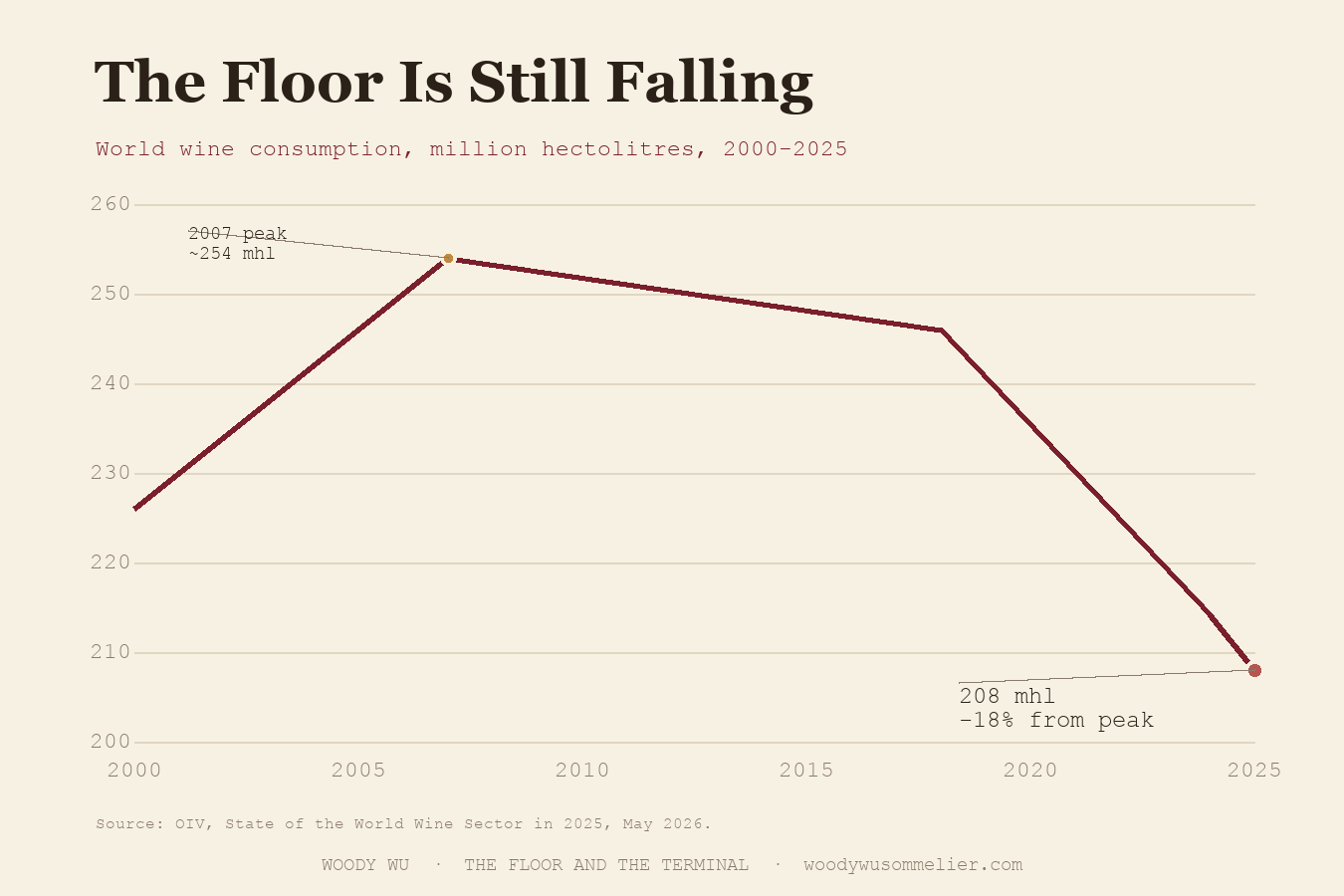
Wine consumption is not falling because one generation woke up and decided to destroy civilization. Global wine consumption is now estimated at 208 million hectolitres, down 2.7% from 2024 and roughly 18% below the 2007 peak. Production is still low, only 0.6% above the historically weak 2024 level. Global vineyard area contracted again. Export volume fell. Export value fell even faster
This is not a murder mystery.
This is a renovation notice.
The first thing to say is the obvious thing, because the wine business has become very good at making the obvious sound impolite. The decline is real. It is long. It is structural. It did not begin with the youngest legal drinkers, and it will not be fixed by a brand deck explaining that Pinot Grigio is fun now.
The shape of the line matters. The peak was 2007. That was before most of the current Gen Z discourse had learned to spell hangover. The deeper slide began before the latest wave of wellness culture became a beverage strategy. The industry wants a young villain because a young villain allows the old model to remain innocent.
It is not innocent.
For decades, the volume side of wine made a simple bet: make enough acceptable wine, dress it in enough aspiration, and let habit do the rest. The customer would drink more, trade up occasionally, and accept vagueness as romance. The trade could say “lifestyle” when it meant margin. It could say “approachable” when it meant flattened. It could say “premium” until the word gave up and sat quietly in the corner.
That customer is leaving.
Or more precisely, that customer is becoming more selective, which looks like leaving if your entire model depended on low selectivity.
The second thing to say is that the vineyard has already understood this. The world vineyard surface fell again in 2025. The OIV estimates 7.0 million hectares, down 0.8%, the sixth consecutive contraction. France dropped 4.4%. Chile dropped 3.7%. Argentina, Spain, and the USA also moved down. Brazil and India moved up
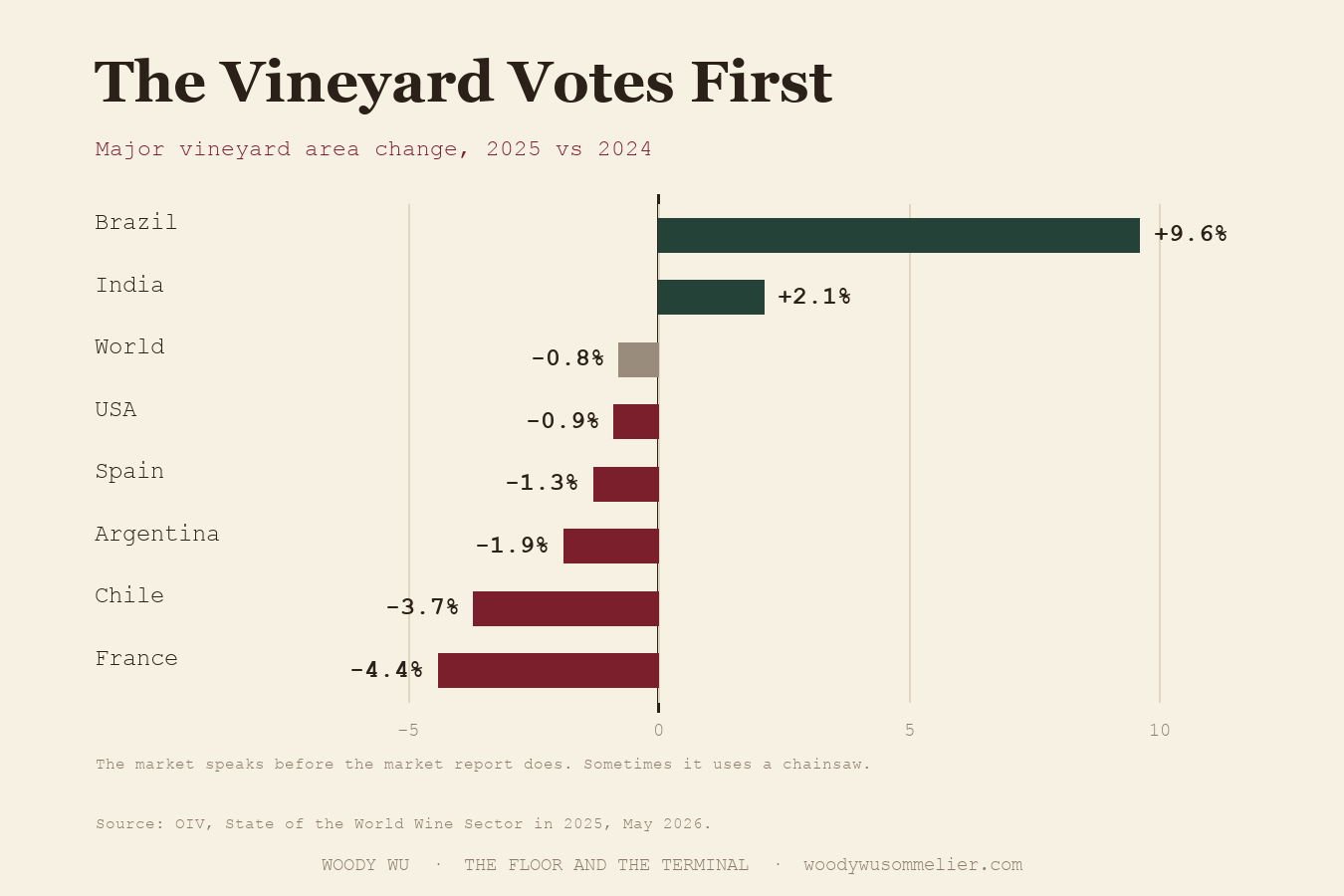
The vineyard votes first.
Before the panel discussion, before the marketing reset, before the consultant gets paid to rename the same bottle in a softer font, the land starts answering the harder question: does this hectare still make sense?
In some places the answer is yes. In others, no. That is painful, but pain is not always a sign of death. Sometimes pain is the proof that a body is no longer willing to carry what does not serve it.
I do not say this casually. I work on the floor. I have watched guests hesitate over bottles they would have bought without blinking five years ago. I have watched the same guests happily spend more when the bottle had a reason, a story, a texture, a human being behind it, and a person in front of them able to explain why it belonged on the table.
That is the split.
Cheap meaning is dead. Real meaning is not.
The third thing to say is that trade is showing the same pressure. In 2025, world wine exports fell to 94.8 million hectolitres, down 4.7%. Export value fell to 33.8 billion EUR, down 6.7%
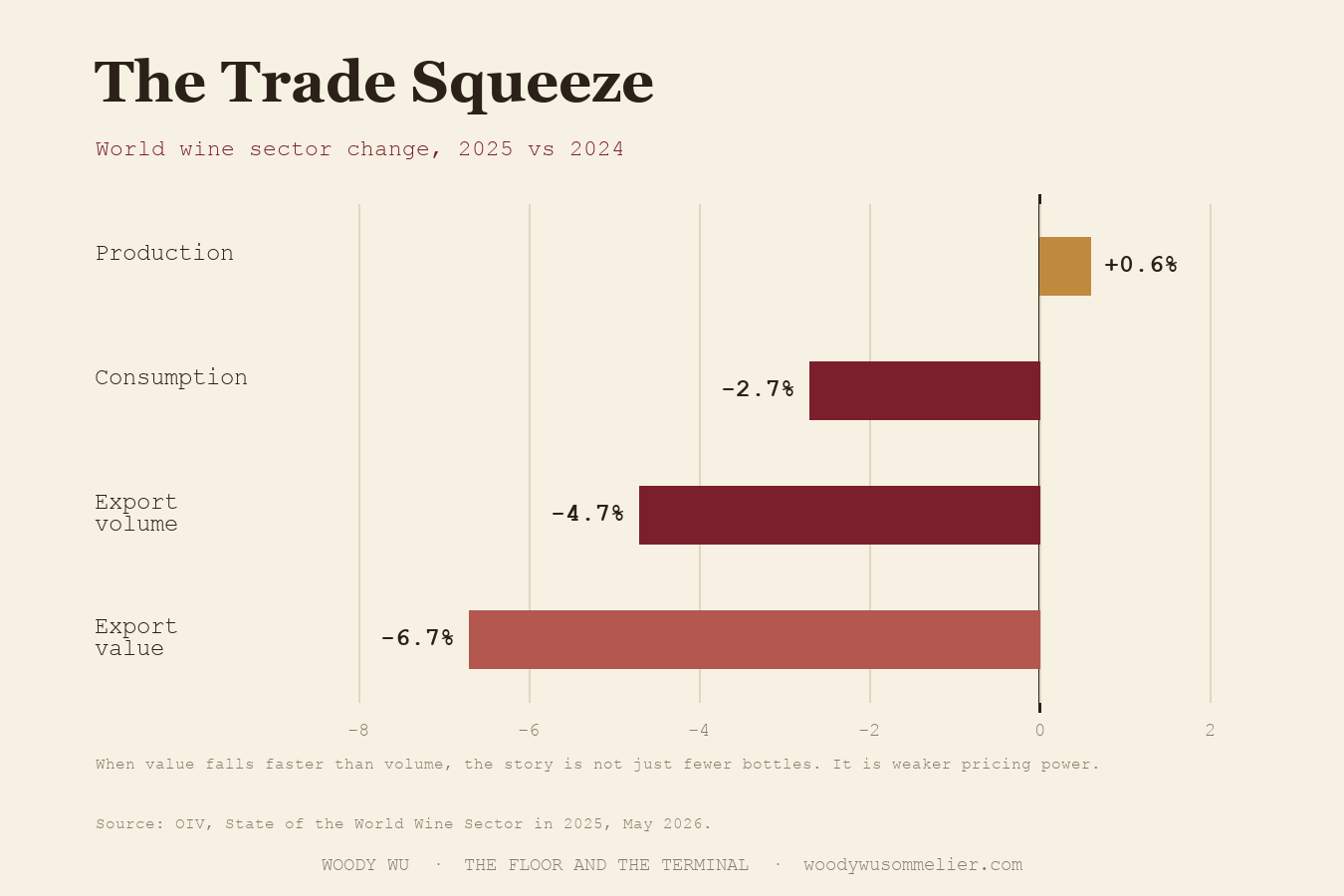
That gap is the quiet alarm.
When volume falls, you can blame demand. When value falls faster than volume, you have to talk about pricing power. That is where the room gets uncomfortable, because pricing power is not created by calling something premium. It is created when the customer believes the exchange.
The exchange is the whole game now.
This is why I do not buy the lazy decline story. The data is not saying wine has no future. The data is saying wine no longer gets automatic permission. A bottle has to justify its place in the fridge, in the cellar, on the list, on the expense account, on the anniversary table, and inside the body of a drinker who is increasingly aware that pleasure has a cost.
That cost is not only money.
It is health. Attention. Time. Identity. Sleep. The morning after. The feeling of whether the thing was worth it.
This is where the younger drinker is not the problem. They are the early warning system. The legal-age Gen Z drinker is not asking the wine business an irrational question. They are asking a devastatingly rational one:
Why this?
Not why wine. Why this wine? Why this bottle? Why this markup? Why this story? Why this night? Why this amount? Why this thing, when I have a thousand other ways to spend the same money and protect the same tomorrow morning?
That question does not kill wine.
It kills lazy wine.
The Wine Market Council’s 2025 benchmark findings made the generational story more interesting than the trade wanted it to be. Millennials became the largest single group of U.S. wine drinkers. Gen Z share rose from 9% to 14%, even while much of the cohort is still aging into legal purchasing. The group blamed for abandoning wine was, in the data, not quite behaving like an assassin.
The industry did not lose the young drinker. It lost the permission to be vague.
I think this is excellent news, which is not the same as saying it is comfortable news.
The next wine market will be smaller in volume and more severe in taste. It will punish the bottle that has nothing to say. It will punish the restaurant list that treats by-the-glass as a dumping ground. It will punish the importer who hides behind scarcity without service. It will punish the sommelier who mistakes vocabulary for trust.
Good.
Wine should be hard to fake.
The business had a long run where the appearance of taste was often enough. The new drinker is less impressed by appearance because every consumer category has been selling them appearance since childhood. They can smell branding the way a cellar smells cork taint. They may not have the language yet, but they have the allergy.
What they want is not less wine in the spiritual sense.
They want fewer lies per glass.
That is where the opportunity lives. The great mistake would be trying to seduce this customer back into the old model with younger packaging. The better move is to become more adult than the market around you. More transparent. More specific. More useful. More honest about price. More careful about alcohol. More serious about the fact that a guest can love wine and still decide not to drink much of it.
I am sober. I still work with wine. That makes the current market less confusing to me than it seems to be for some people. The future of wine is not the guest who drinks without thinking. It is the guest who thinks and still chooses the glass.
That guest is harder to earn.
That guest is better.
If you sell wine, stop grieving the old volume and start earning the new meaning. If your bottle is honest, this is your era. If your list is built with care, this is your era. If your service can explain value without bullying the guest, this is your era. If your only argument is that wine has always mattered, the market is about to be very educational.
Nobody is killing wine.
The cheap story is dying. The lazy bottle is dying. The vague markup is dying. The assumption that people will drink because people have always drunk is dying.
What remains could be better.
Smaller, yes. More demanding, yes. Less forgiving, absolutely.
But better.
The bottles that survive will be the ones with nothing to hide.
I intend to be pouring them.
Woody
Tasted, never swallowed.
Sources: OIV, State of the World Wine Sector in 2025, May 2026; Wine Market Council 2025 U.S. Wine Consumer Benchmark Segmentation Survey, via Food & Wine reporting.