Champagne fell for the third year in a row.
The trade headlines called it a crisis.
I looked at the ownership map.
Here is the number that reframes the whole panic. Growers own and tend nearly 90 percent of the vineyard in Champagne. The land, the labor, the farming risk, the actual chalk that makes the wine worth the bottle.
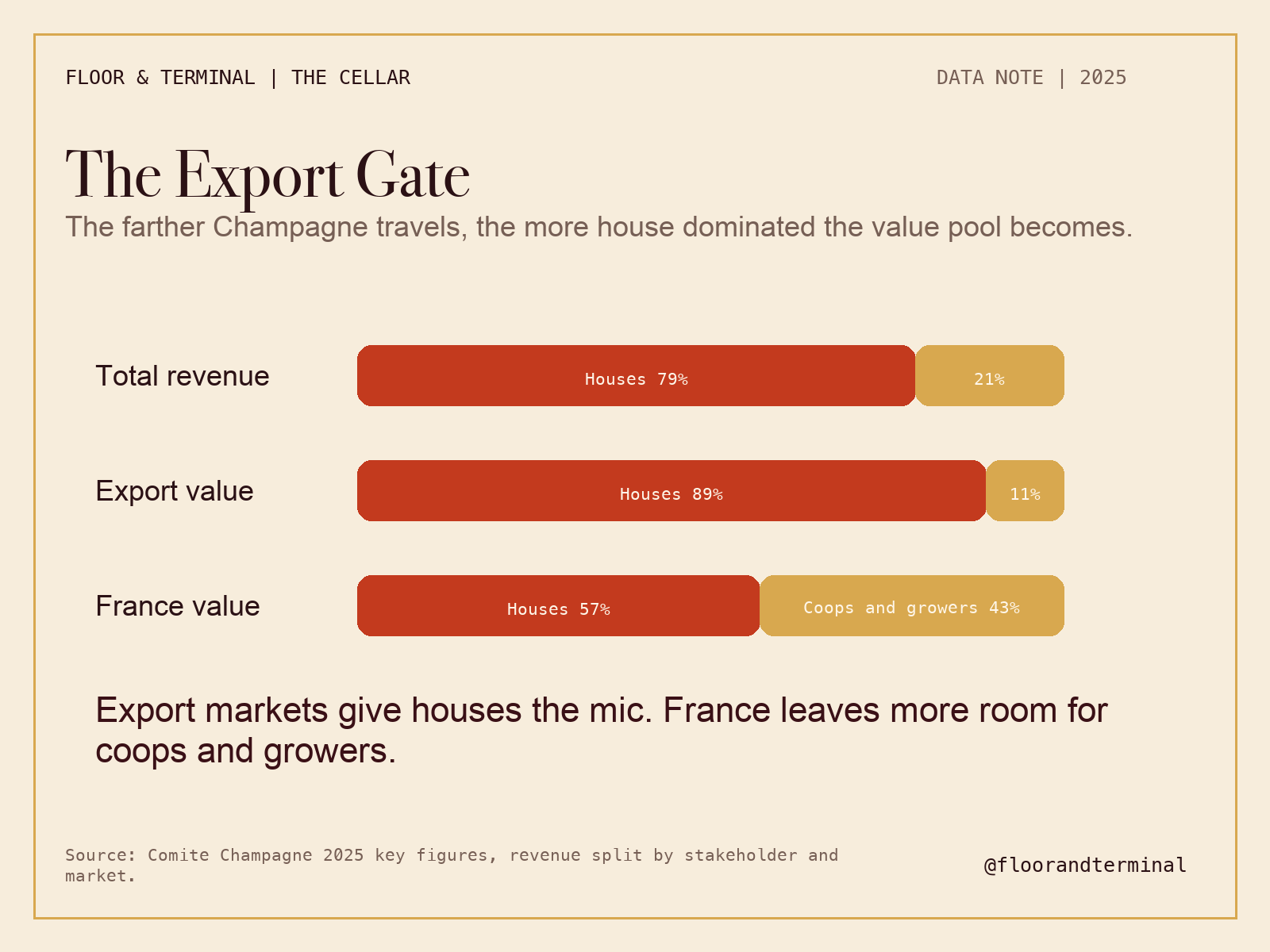
But in export value, the houses capture 89 percent.
Own the dirt. Miss the mic.
That is the real map.
The houses are having a hard few years. The farmers have the more interesting story. Let me show you the data, because once you see it, you cannot unsee it.
The houses have a problem
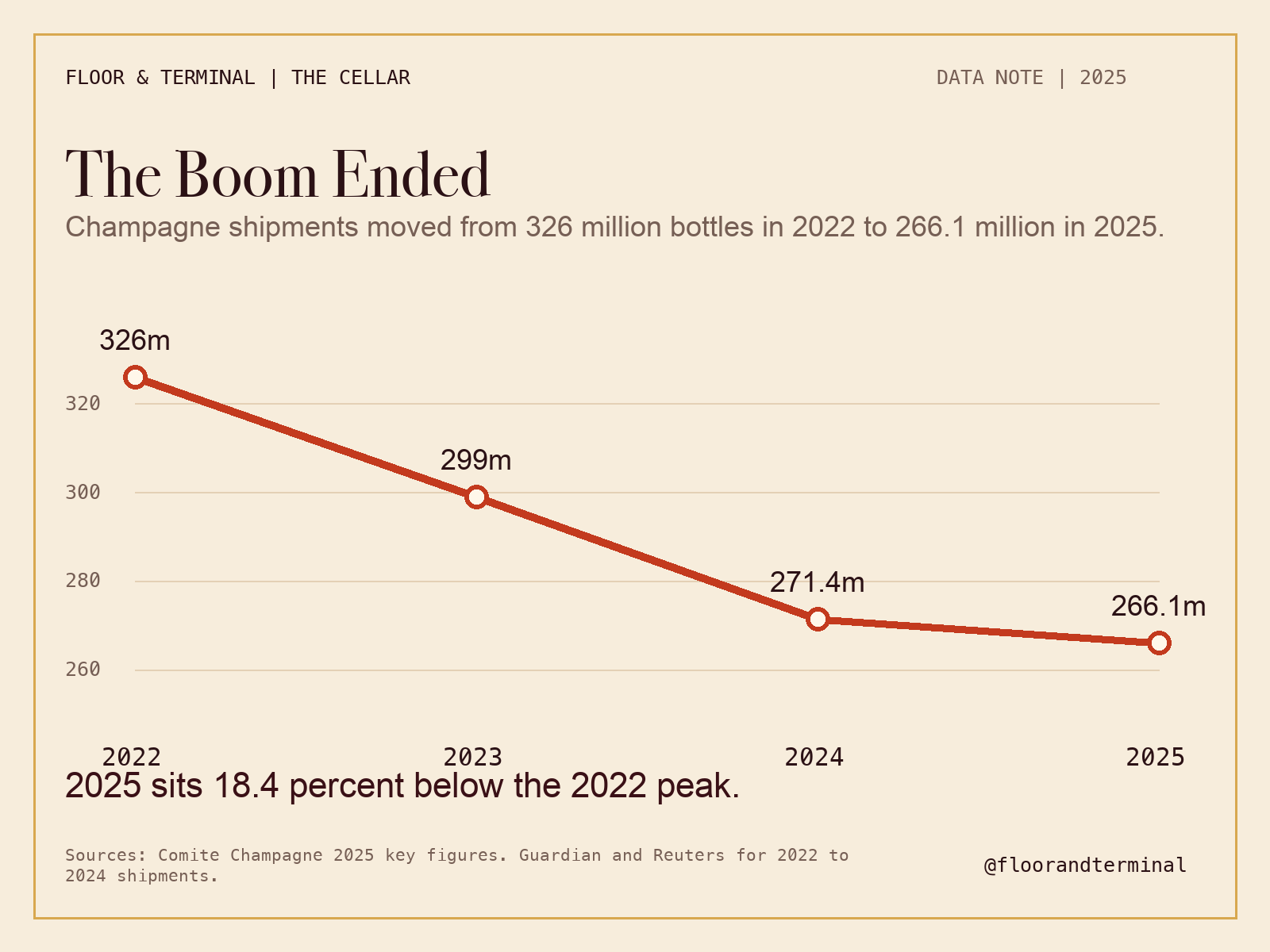
Global Champagne shipments peaked at 326 million bottles in 2022, the big rebound year after the pandemic. They fell to about 299 million bottles in 2023, 271.4 million in 2024, and 266.1 million in 2025.
Three straight years of decline.
You can blame the economy, tariffs, geopolitics, and changing habits, and you would be partly right. But a category that sells on occasion and status is uniquely exposed the moment people get careful with money.
The house model was built for the boom.
Now here is the part the crisis coverage skips.
They own the land. They do not get the money.
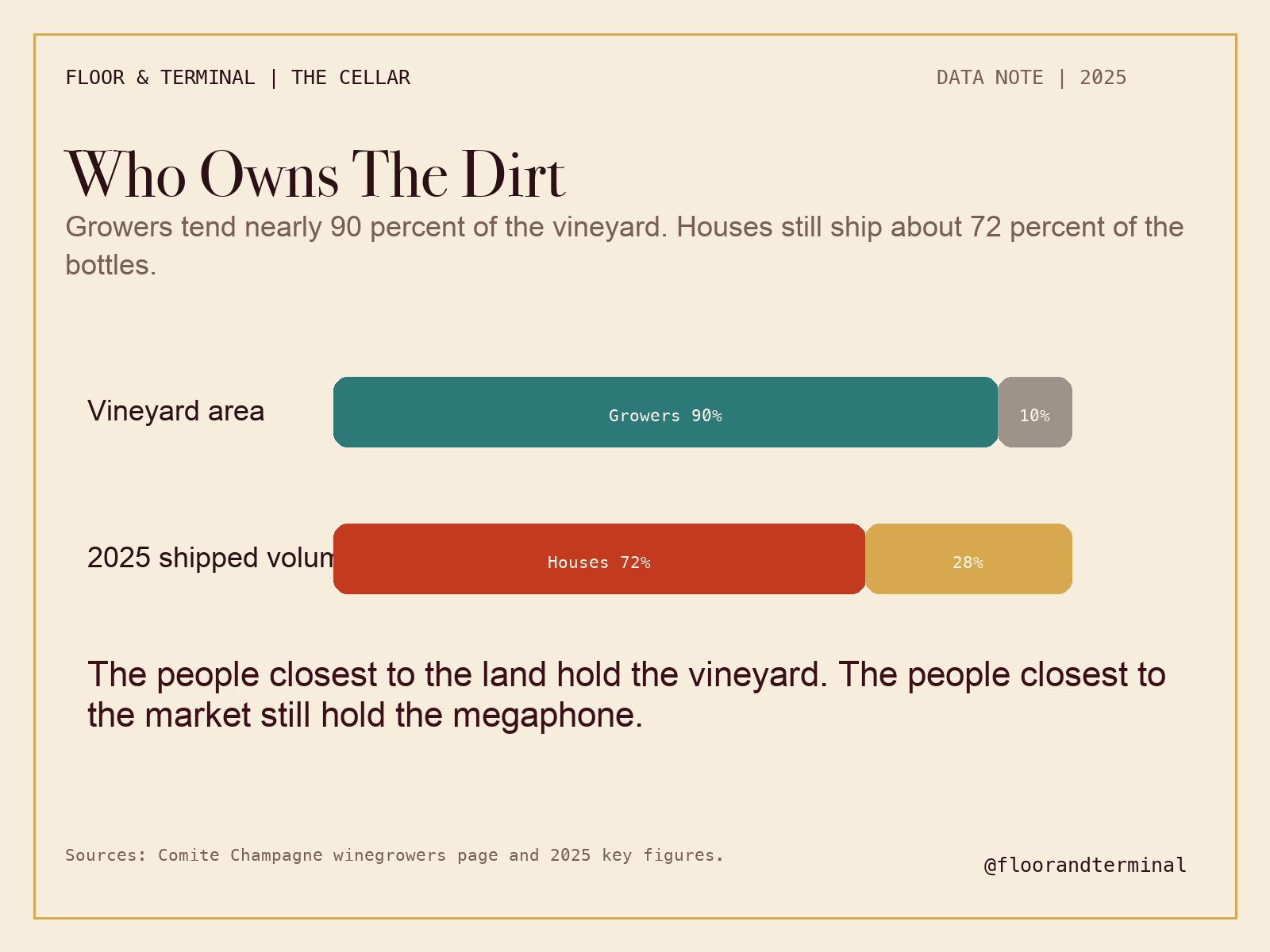
The growers, the ones labeled RM in letters so small you have to know to look, own and tend nearly 90 percent of the Champagne vineyard.
They farm the slopes. They carry the cost of frost and hail. They make wine from their own fruit, in their own villages.
The houses, 410 of them in the official 2025 figures, own a much smaller share of the land. They buy grapes. They blend across villages, across years, across thousands of growers, to build a house style that tastes consistent every time it is opened.
And they still ship most of the bottles.
In 2025, houses shipped 191.9 million bottles out of 266.1 million total. That is about 72 percent of volume.
In export value, houses captured 89 percent. Cooperatives and growers captured 11 percent.
Read that again.
The people who own the dirt do not own the story.
Neither side is illegitimate. A great house can make a real product. But only one side of this map is scarce in the way wine people usually claim to care about. A place. A farmed slope. A family decision. A risk carried in one village instead of smoothed across the whole region.
That is where the useful story starts.
What you actually pay for
When a guest buys a grande marque, a real share of the price is the box.
The marketing.
The airport lightbox.
The global distribution machine.
The wine inside can be genuinely lovely. The guest is still paying for a famous name that happens to contain Champagne.
When a guest buys from a grower, the line between land, labor, risk, and price gets shorter.
No racing budget.
No celebrity.
No airport theatre.
A name, a village, and a person who was out in the vines when the weather turned.
Grower Champagne is interesting for one plain reason: it shortens the distance between place and glass.
That is not romance.
That is the receipt.
The math just turned
The United States is the prize.
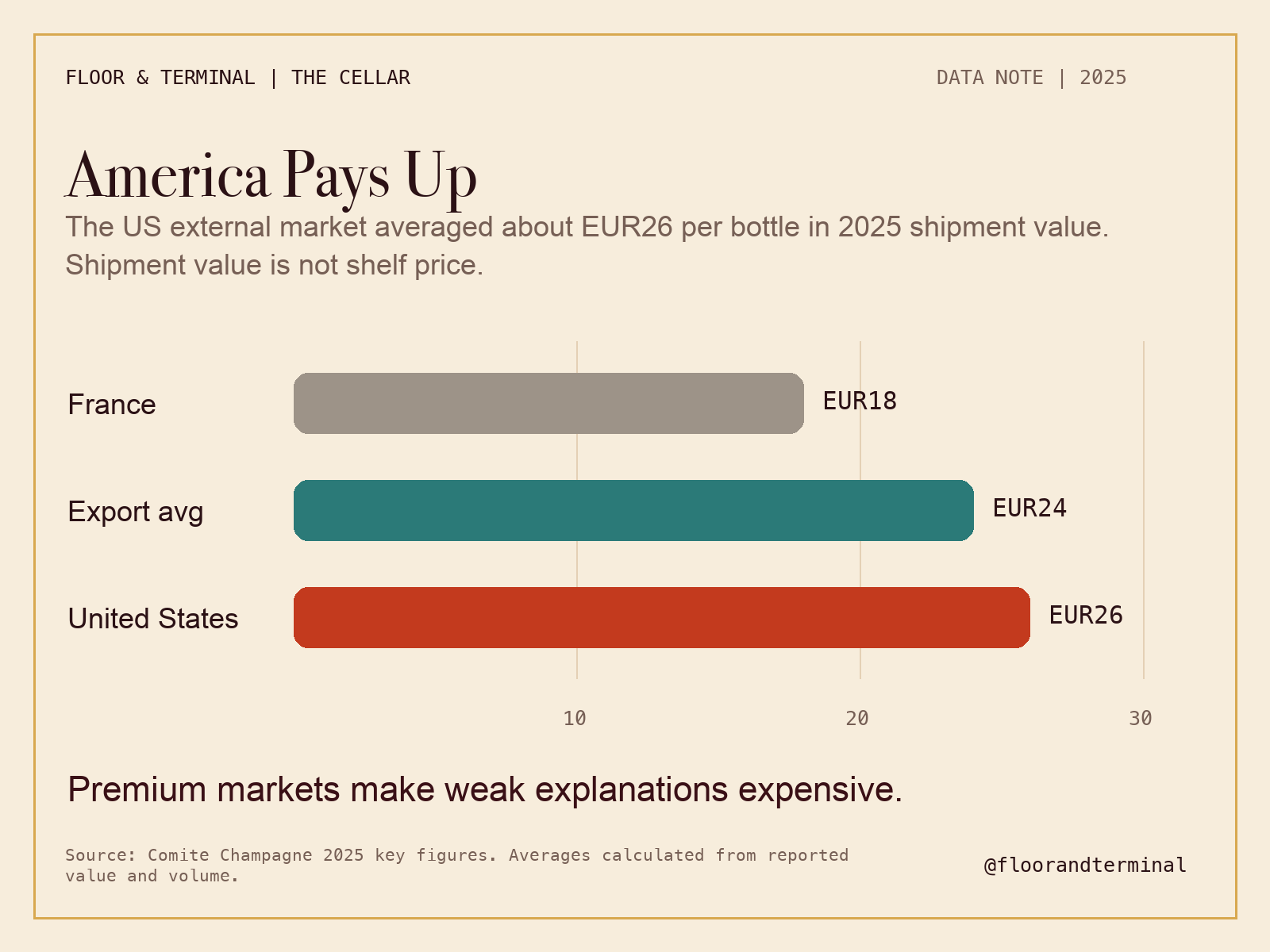
In 2025, the US was Champagne’s top external market by both volume and value: 26.5 million bottles and EUR689 million.
That works out to about EUR26 per bottle in shipment value before shelf pricing, restaurant markup, freight, and everything else.
France averaged about EUR18 per bottle. The global average was about EUR21. Export markets averaged about EUR24.
So yes, America pays up.
But expensive is not the problem.
Unexplained expensive is.
When the market tightens, the bottle has to explain itself faster. A famous label can still win. But it has to earn the room. A grower can win too, if the story is legible enough for the server to translate under pressure.
That is the operator lesson.
The best bottle is not the one with the loudest story.
It is the one the room can actually explain.
The useful window
I would not call this the end of Champagne.
That is too easy, and easy stories usually miss the money.
The better read is that the market is asking better questions.
What is the bottle?
Who made it?
Where is the value?
Why this price?
Why this glass?
Why now?
Grower Champagne answers those questions differently. Not always better. Not automatically. But differently in a way that matters when guests are more skeptical, buyers are more careful, and the old luxury script is not enough on its own.
This is not about hating houses.
It is about reading the map.
The houses will be fine. They usually are.
But the next interesting decade in Champagne belongs to the people who own and tend the vines, and who are slowly getting the mic.
Nobody owns Champagne.
But if you want to understand where the next useful story comes from, start with the people who own the dirt.
Woody
Reply prompt
What Champagne label made the farm visible to you?
The grower, the moment, the room. Reply and tell me. I read everything.
Sources: Comité Champagne 2025 key figures and Champagne Winegrowers; The Guardian with Reuters shipment context; Wine-Searcher U.S. Champagne market context.